The Robotics Revolution
A comprehensive guide to publicly traded robotics companies on US exchanges, from humanoid robots to AI infrastructure and warehouse automation systems.
Executive Summary
The robotics industry represents one of the most transformative technological opportunities of the next decade, with NVIDIA estimating a $50 trillion "physical AI" market opportunity. For pure-play robotics exposure, Symbotic (SYM) leads warehouse automation with 118% YTD gains, while Intuitive Surgical (ISRG) dominates medical robotics with 10,000+ installed systems.
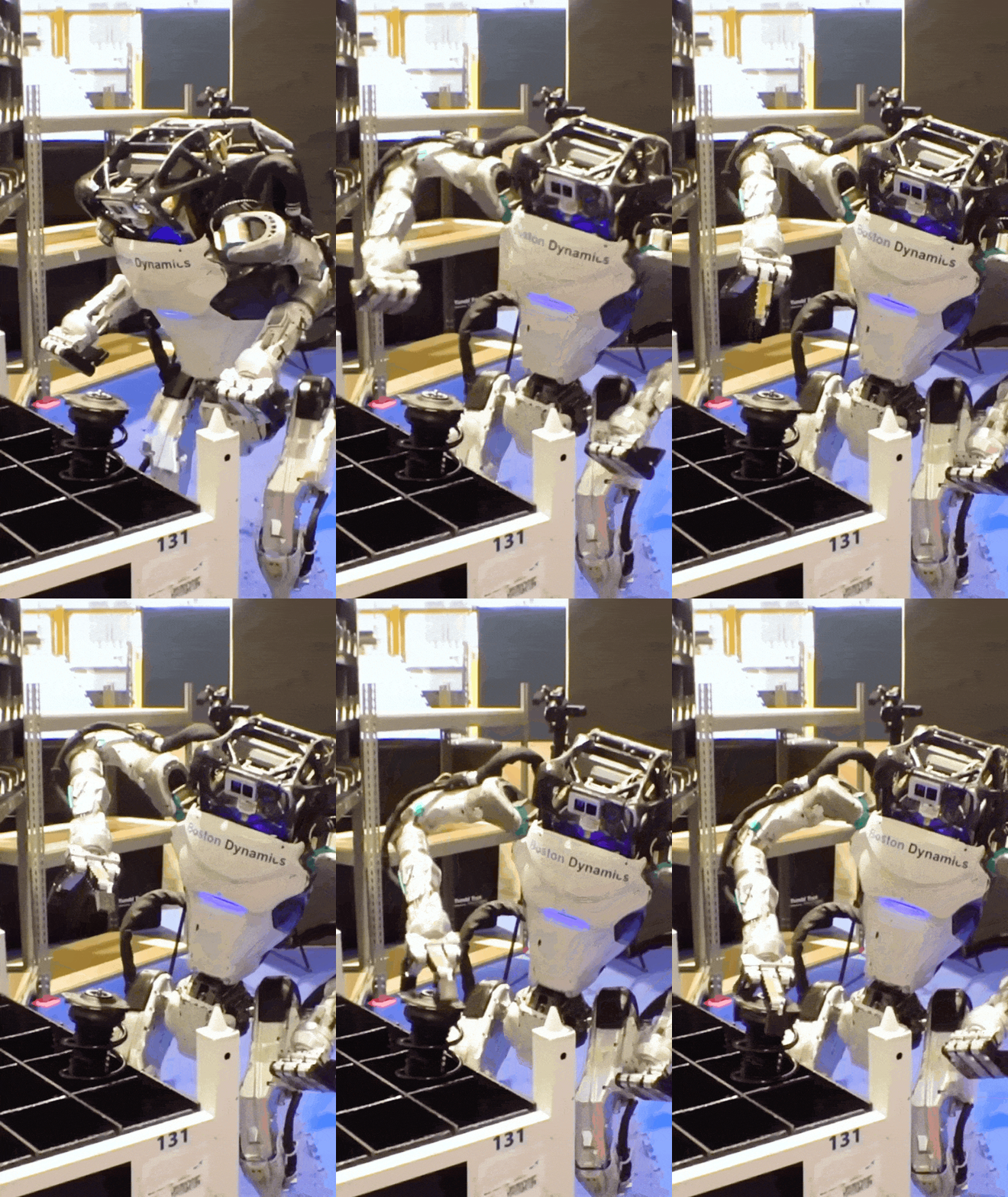
NVIDIA (NVDA) is the essential infrastructure play—its GR00T foundation model and Jetson platform power virtually every major humanoid robot developer. For humanoid-specific exposure, Boston Dynamics via Hyundai (HYMTF) offers the most advanced capabilities entering production, with 30,000 humanoid robots annually targeted by 2028.
Small-cap medical robotics like PROCEPT BioRobotics (PRCT) and Stereotaxis (STXS) provide higher-risk, higher-reward options. Most "robotics" ETFs are diluted with industrial automation—direct stock selection offers better pure-play exposure.
Companies Producing Physical Robots
Large-Cap Companies (Market Cap > $10 Billion)
NVIDIA Corporation
NASDAQ: NVDANVIDIA has constructed the most comprehensive full-stack robotics platform in the industry, despite not manufacturing physical robots in the traditional sense. The company's strategic pivot toward robotics infrastructure accelerated dramatically in 2024-2025, with its Isaac GR00T foundation model establishing NVIDIA as the essential AI infrastructure provider for humanoid robotics development.
The Jetson Thor, specifically architected for humanoid robots, delivers 2,000 teraflops of AI performance at power levels suitable for battery-operated platforms. NVIDIA's platform dominance is such that nearly all major humanoid robot developers utilize its technology, including Boston Dynamics, Figure AI, Agility Robotics, and XPeng Robotics.
Intuitive Surgical Inc.
NASDAQ: ISRGIntuitive Surgical stands as the undisputed pioneer and market leader in robotic-assisted surgery, with an installed base of 10,763+ da Vinci systems globally and more than 14 million procedures completed. The da Vinci 5 system incorporates enhanced force feedback technology and AI-powered Force Gauge visual indicators.
Tesla Inc.
NASDAQ: TSLATesla represents the most ambitious humanoid robotics investment among large-cap companies. CEO Elon Musk has projected that Tesla's Optimus humanoid robot could eventually represent 80% of the company's value, with potential to make Tesla a $25 trillion company based on mass deployment of general-purpose humanoid robots.
Mid-Cap Companies (Market Cap $2–$10 Billion)
Symbotic Inc.
NASDAQ: SYMSymbotic has emerged as the leading pure-play warehouse automation company, with AI-powered robotic systems deployed at Walmart, Target, and Costco. The company's comprehensive system architecture integrates autonomous mobile robots, high-density storage structures, and AI-powered orchestration software.
Small-Cap Companies (Market Cap < $2 Billion)
PROCEPT BioRobotics Corp.
NASDAQ: PRCTPROCEPT offers a larger small-cap alternative with more established commercial presence, developing the Aquablation robotic system for prostate surgery. The technology uses image-guided waterjet ablation rather than thermal energy for benign prostatic hyperplasia (BPH) treatment.
Companies Developing AI and Software for Robotics
Large-Cap AI and Software Platforms
UiPath Inc.
NYSE: PATHUiPath has established leadership in robotic process automation (RPA), with strategic evolution toward "agentic AI orchestration" that combines traditional software robots with emerging AI agent capabilities. The March 2025 acquisition of Peak AI enhanced the platform with specialized decision-making agents.
Mid-Cap Specialized AI and Software
Ambarella Inc.
NASDAQ: AMBAAmbarella develops edge AI semiconductors specifically for robotics, autonomous vehicles, and drones. The company's focus on low-power, high-efficiency AI inference addresses critical requirements for battery-powered and thermally constrained robotic systems.
Sector-Specific Robotics Applications
AVAV
Puma Drones"] B --> B2["Raytheon
RTN
Coyote Counter-Drone"] C --> C1["Intuitive Surgical
ISRG
da Vinci Systems"] C --> C2["Stryker
SYK
Mako Platform"] C --> C3["PROCEPT
PRCT
Aquablation"] D --> D1["Rockwell Automation
ROK
OTTO AMR"] D --> D2["ABB
ABBNY
YuMi Cobot"] D --> D3["Fanuc
FANUY
CRX Series"] E --> E1["Deere & Company
DE
Autonomous Tractors"] E --> E2["See & Spray
Technology
Precision Agriculture"] F --> F1["Serve Robotics
SERV
Sidewalk Delivery"] F --> F2["Richtech Robotics
RR
Hospitality Robots"] style A fill:#f5f5f3,stroke:#1a1a1a,stroke-width:3px,color:#2d2d2d style B fill:#e8f4fd,stroke:#1e40af,stroke-width:2px,color:#1e293b style C fill:#f0fdf4,stroke:#166534,stroke-width:2px,color:#1e293b style D fill:#fdf4ff,stroke:#7c3aed,stroke-width:2px,color:#1e293b style E fill:#fef3c7,stroke:#d97706,stroke-width:2px,color:#1e293b style F fill:#fce7f3,stroke:#be185d,stroke-width:2px,color:#1e293b style B1 fill:#ffffff,stroke:#3b82f6,stroke-width:2px,color:#1e293b style B2 fill:#ffffff,stroke:#3b82f6,stroke-width:2px,color:#1e293b style C1 fill:#ffffff,stroke:#22c55e,stroke-width:2px,color:#1e293b style C2 fill:#ffffff,stroke:#22c55e,stroke-width:2px,color:#1e293b style C3 fill:#ffffff,stroke:#22c55e,stroke-width:2px,color:#1e293b style D1 fill:#ffffff,stroke:#8b5cf6,stroke-width:2px,color:#1e293b style D2 fill:#ffffff,stroke:#8b5cf6,stroke-width:2px,color:#1e293b style D3 fill:#ffffff,stroke:#8b5cf6,stroke-width:2px,color:#1e293b style E1 fill:#ffffff,stroke:#f59e0b,stroke-width:2px,color:#1e293b style E2 fill:#ffffff,stroke:#f59e0b,stroke-width:2px,color:#1e293b style F1 fill:#ffffff,stroke:#ec4899,stroke-width:2px,color:#1e293b style F2 fill:#ffffff,stroke:#ec4899,stroke-width:2px,color:#1e293b
Defense & Military Robotics
The defense robotics sector combines substantial government funding with unique operational requirements that create differentiated competitive dynamics.
- AeroVironment (AVAV): Puma surveillance drone, Switchblade loitering munition
- Raytheon (RTN): Coyote counter-drone system with swarming capability
- Boeing (BA): Echo Voyager unmanned submarine, X-37B autonomous space vehicle
Healthcare & Rehabilitation
The surgical robotics sector represents one of the most clinically validated and economically attractive robotics applications.
- Intuitive Surgical (ISRG): 10,763+ da Vinci systems, 14M+ procedures
- Stryker (SYK): Mako robotic-arm for orthopedic surgery
- PROCEPT (PRCT): Aquablation system for prostate surgery
Key Investment Considerations by Market Capitalization
Large-Cap Stability
- Strong cash flows and minimal financing risk
- Substantial R&D budgets for sustained innovation
- Multiple product lines and geographic diversification
- Often diluted by non-robotics businesses
- Full valuation reflecting growth potential
Small-Cap Opportunity
- Highest pure-play robotics exposure
- Potential for extraordinary returns
- Limited financial resources
- Regulatory and clinical development risks
- Dependence on capital market access
Practical Investment Guidance
Portfolio Construction Approaches
| Approach | Implementation | Best For |
|---|---|---|
| Platform/Infrastructure | NVIDIA (NVDA) | Belief that infrastructure providers capture value regardless of winner |
| Established Medical Leader | Intuitive Surgical (ISRG) | Defensive growth with recurring revenue and clinical moats |
| Pure-Play Warehouse | Symbotic (SYM) | High-conviction e-commerce logistics growth |
| Humanoid Optionality | Tesla (TSLA) or Hyundai (HYMTF) | Acceptance of high risk for transformative upside |
| Diversified Mid-Cap | Teradyne (TER), UiPath (PATH), Ambarella (AMBA) | Balanced exposure across robotics value chain |
| Small-Cap Medical | PROCEPT (PRCT), Stereotaxis (STXS) | High risk tolerance, specialized clinical expertise |
Key Due Diligence Questions
For Physical Robot Manufacturers:
- • What is the path to economic unit costs?
- • Is there demonstrated product-market fit?
- • What are the competitive moats?
- • Are there scalable customer relationships?
For AI/Software Developers:
- • Is there platform ecosystem lock-in?
- • What is the revenue model predictability?
- • How sustainable is differentiation?
- • What are management's robotics credentials?